

Most senior professionals can describe next quarter's priorities in detail. Few can say when they last felt properly rested.
The calendar is full and the reserve is empty. Nobody plans it that way. It happens through a long series of reasonable decisions: one more meeting, one more flight, a workout moved to "next week", a holiday shortened by an urgent call. Each choice makes sense alone. Together they create a life where wellbeing is always scheduled for later.
This article looks at why wellbeing for busy professionals gets deferred, and it offers a practical way to review your patterns. It also makes a point that wellness writing often skips. Persistent tiredness is not always a lifestyle problem, and it should not be treated as one by default.
Why Wellbeing Keeps Getting Deferred
Deferral rarely comes from ignorance. Capable professionals know that sleep, movement and recovery matter. The trouble is structural.
Urgency beats importance. Work arrives with deadlines, stakeholders and visible consequences. Personal wellbeing has none of these. No one sends a reminder when your energy is declining, so it loses every competition for time.
Tiredness becomes normal. When exhaustion lasts for years, it stops feeling like a signal. It starts to feel like your baseline.
Identity is tied to availability. In demanding roles, being responsive becomes part of who you are. Protecting personal time can feel like letting people down, so the boundary is pushed back, quietly and repeatedly.
"After this project" never arrives. There is always a launch, a funding round or a busy season. The next milestone is already forming behind the current one.
Deferral is not a character flaw. It is the predictable result of a system that rewards output and does not measure reserves.

What a Depleted Reserve Looks Like
Depletion seldom announces itself with a crash. It tends to appear in smaller, easy-to-excuse ways:
- Needing caffeine to start the day and again to survive the afternoon.
- Sleeping a full night but waking unrefreshed.
- Shorter patience with colleagues or family.
- Difficulty switching off, even on weekends.
- Declining focus, or decisions that feel heavier than they used to.
- Losing interest in things that once brought enjoyment.
- Treating rest as something to earn, then feeling guilty when you take it.
None of these proves anything on its own. Together, and especially when they persist, they suggest the reserve deserves attention.
Tiredness Is Not Always a Lifestyle Issue
The wellness industry often implies that fatigue has one cause: too little sleep, too much stress, too little discipline. That framing is tidy, but it is incomplete, and it can be harmful.
Ongoing tiredness can have many sources. Some relate to work and habits. Others are medical, such as thyroid conditions, anaemia, nutritional deficiencies, sleep disorders including sleep apnoea, blood sugar problems, hormonal changes, medication side effects, or mood conditions such as depression and anxiety. Only a qualified clinician can tell these apart.
If you have been tired for weeks or months despite reasonable sleep, or if your fatigue is new, worsening or accompanied by other symptoms, do not assume you simply need to "manage your time better". Please speak with a doctor. Unexplained weight change, persistent low mood, breathlessness, chest discomfort, loud snoring with daytime sleepiness, or fatigue that does not improve with rest all warrant a medical conversation.
A sound approach to executive wellbeing holds both ideas at once. Your work patterns may be contributing, and something may also need medical investigation.

A Realistic Framework: Review, Rest, Reprioritise
Most professionals do not need a dramatic reinvention. They need a calm, honest review, which takes about an hour, followed by a few small experiments.
1. Review your work patterns
Look back over the last four weeks of your calendar and ask:
- How many hours a week do I spend in meetings, and how many need me specifically?
- When does my real thinking happen, and is that time protected?
- How often do I work evenings or weekends, and is that exceptional or routine?
- Which recurring commitments would I decline if offered today?
- How much of my travel is essential?
Mark each recurring commitment as essential, useful or habitual. Habitual items are often the easiest to shorten, delegate or retire.
2. Review your rest
Rest is more than sleep, although sleep is the foundation. Consider its forms:
- Sleep: consistent timing, quality, and how you feel on waking.
- Mental rest: time without screens, notifications or problem-solving.
- Physical recovery: restorative movement and deliberately lighter days.
- Social and emotional rest: time with people who ask nothing of you.
- Sensory rest: quiet, nature and low stimulation.
For one week, note when you actually rest, not when you think you should. Many people find their "downtime" is spent answering messages, which is stimulation and not recovery.
Then picture your energy as a bank balance. What are your regular deposits, and what are your regular withdrawals? A reserve empties when withdrawals outpace deposits for long enough. The fix is usually a modest, consistent increase in deposits.
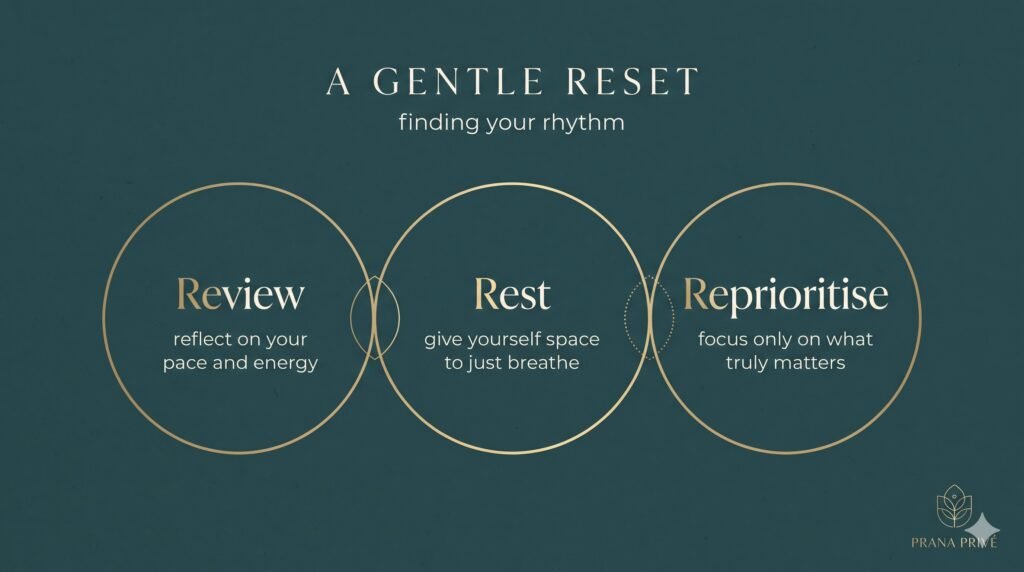
3. Reprioritise your personal commitments
Write down the three to five personal priorities you would defend if asked. These might be health, a marriage, time with children or ageing parents, a creative pursuit, friendships or solitude.
Then check the calendar. Do these priorities appear anywhere? If they exist only as intentions, they are the first thing to be displaced. Work-life balance is often described as an even split of hours, which is neither realistic nor necessary. A better question is whether the things you value most receive reliable, protected time, even if that time is modest.
Small Moves That Hold
Large resolutions tend to collapse in the first busy fortnight. Smaller structural changes survive.
- Book personal time like a board meeting. If it is not in the calendar, it is a wish.
- Create one buffer. Add fifteen minutes between back-to-back meetings, or keep one half-day a week free of calls.
- Protect a shutdown ritual. Close the laptop, note tomorrow's top three items, and stop.
- Anchor your sleep window. Keep wake and sleep times reasonably consistent, including weekends.
- Move daily, gently. Walking or mobility work supports energy more reliably than occasional intense effort.
- Schedule a periodic health review. Check-ups and appropriate tests, guided by your doctor, replace guesswork with information.
- Decide in advance what you will decline. A personal policy removes the daily negotiation.
Pick one or two and keep them for a month. Progress in executive vitality is usually quiet, cumulative and unglamorous.

When Self-Review Is Not Enough
A framework can clarify your patterns, but it cannot replace professional guidance. Consider seeking support if:
- Fatigue persists despite genuine changes to sleep and workload.
- You notice sustained low mood, anxiety or loss of motivation.
- Your sleep is regularly disrupted or unrefreshing.
- You feel unable to make changes even though you can see what is needed.
- Physical symptoms are new, unexplained or worrying.
Starting with a physician is sensible. From there, support may include a therapist, a sleep specialist, a coach or a structured wellbeing programme. Needing help is not a failure of discipline. It is good decision-making applied to your own health.
Rethinking What Wellbeing Means
For high-performing professionals, personal wellbeing is often framed as a reward for finishing the work, or as a tool for doing more of it. Both framings keep it in second place.
A more durable view treats wellbeing as the condition that makes sustained work and a meaningful life possible. Energy, clarity, patience and presence are the assets every other commitment draws on, and they cannot be topped up at the last minute.
You do not need to overhaul your life to begin. You need an honest look at your calendar, a clearer picture of your rest, and a willingness to put your own priorities where the work cannot easily take them. If tiredness persists, you also need the humility to ask a professional what is going on.
The calendar will probably always be full. The question is whether you are also tending the reserve that carries you through it.

At Prana Privé, we design restorative experiences for professionals who want to pause, reassess and return with greater clarity. If this article raised questions about your own patterns, we would be glad to start a conversation.
Note: This article is for general information and is not medical advice. If you have persistent or concerning symptoms, please consult a qualified healthcare professional.









0 Comments